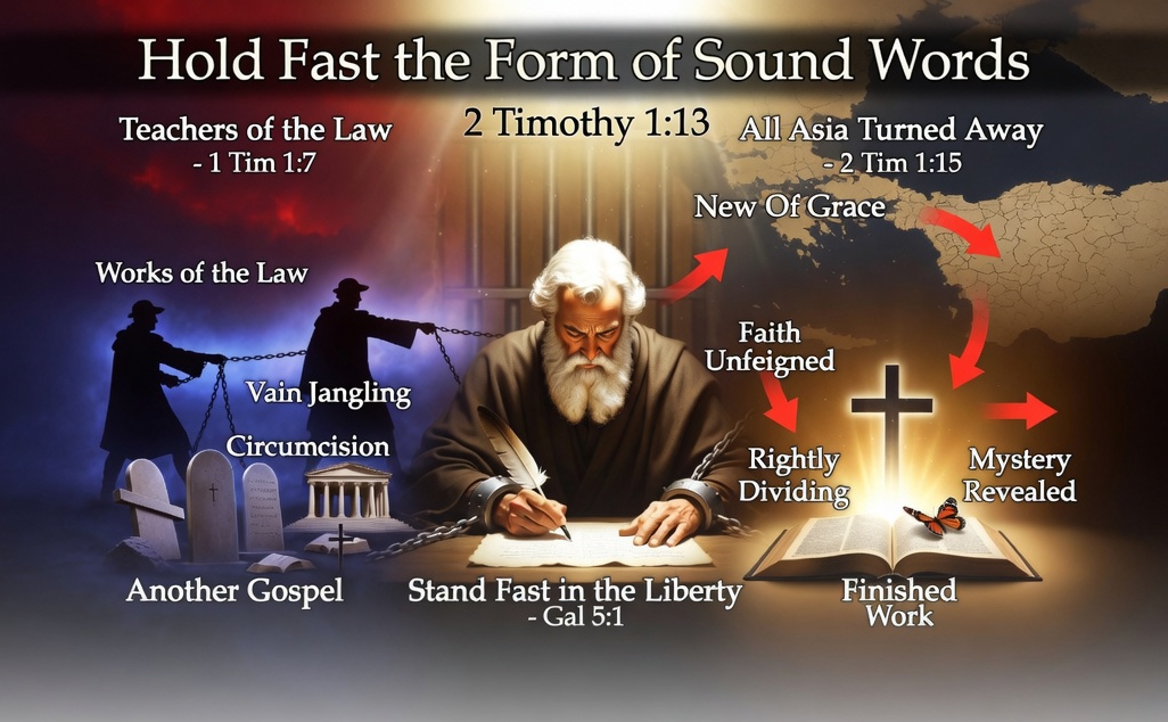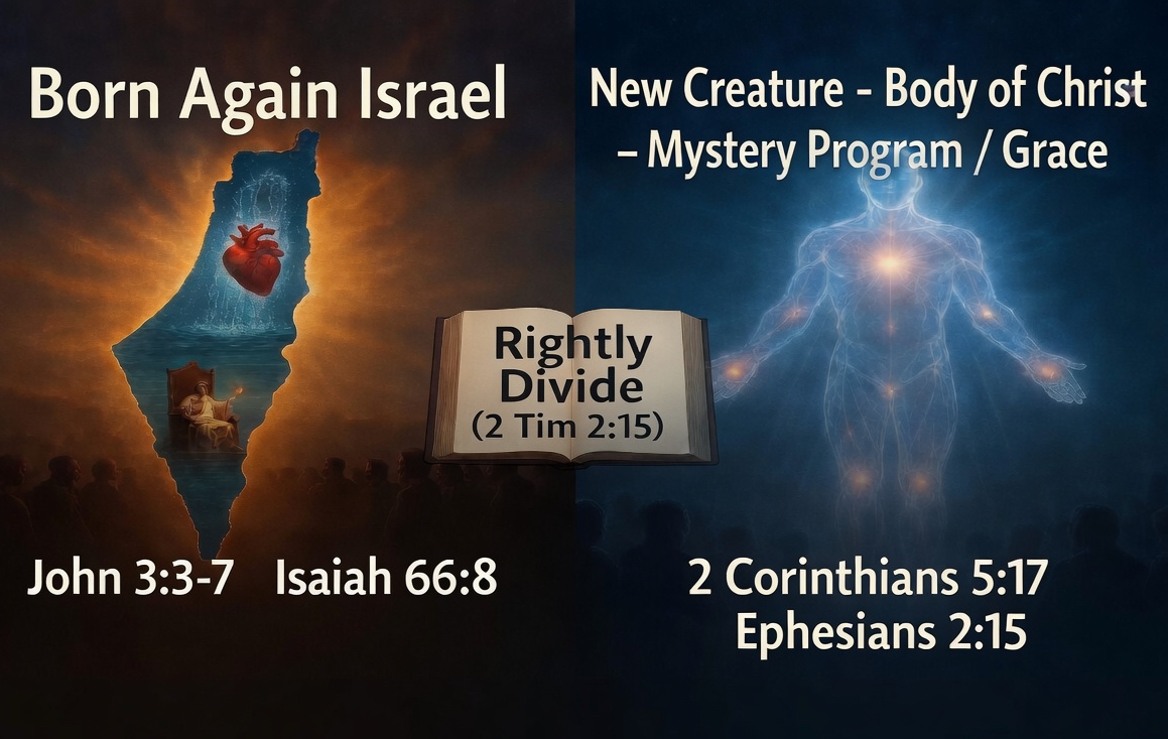
Have you ever noticed how the phrases “born again” and “born of the Spirit” get used as though they are the universal way to describe salvation for everyone in every age? At the same time, Paul—the apostle Christ sent to us Gentiles—uses completely different language to describe what God has done for the body of Christ. Let’s open our King James Bibles and examine these terms carefully so we can see the distinction the Holy Spirit has placed in Scripture. We’ll look at the kingdom context in John 3, Paul’s distinct revelation for us today, and his use of “born after the Spirit” as an allegory. Right division here brings wonderful clarity and keeps us standing fast in the liberty we have in Christ.
“Ye Must Be Born Again” / “Born of the Spirit” — Kingdom Truth for Israel
Jesus speaks directly to Nicodemus, a ruler of the Jews:
“Verily, verily, I say unto thee, Except a man be born again, he cannot see the kingdom of God… Except a man be born of water and of the Spirit, he cannot enter into the kingdom of God. That which is born of the flesh is flesh; and that which is born of the Spirit is spirit. Marvel not that I said unto thee, Ye must be born again.” (John 3:3,5-7 KJV)
Jesus even rebukes him for not knowing these things:
“Art thou a master of Israel, and knowest not these things?” (John 3:10 KJV)
As “a master of Israel,” a teacher and ruler, Nicodemus should have recognized this from the Old Testament prophets. It was not new mystery doctrine being revealed for the first time. It was prophesied kingdom truth—the national regeneration God had promised Israel:
“A new heart also will I give you, and a new spirit will I put within you: and I will take away the stony heart out of your flesh, and I will give you an heart of flesh.” (Ezekiel 36:26 KJV)
The prophets had spoken plainly about Israel’s future cleansing, the pouring out of the Spirit, and their restoration under the King. Isaiah even pictured it dramatically:
“Who hath heard such a thing? who hath seen such things? Shall the earth be made to bring forth in one day? or shall a nation be born at once? for as soon as Zion travailed, she brought forth her children.” (Isaiah 66:8 KJV)
This is Israel being “born in a day”—a national new birth at the time of her restoration. Nicodemus’s confusion is revealing. He took Jesus literally and asked, “How can a man be born when he is old? can he enter the second time into his mother’s womb, and be born?” (John 3:4). He was thinking of a physical, fleshly re-birth. Jesus clarified that the new birth is spiritual: “That which is born of the flesh is flesh; and that which is born of the Spirit is spirit.” “Born of the flesh” simply means natural human birth—the ordinary way every person enters the world. It is not referring to a woman’s water breaking or any specific detail of physical labor. Jesus is drawing a clear contrast: natural, fleshly birth produces flesh; spiritual birth by the Spirit produces spirit. The “water” in verse 5 points to the prophetic cleansing God promised Israel (Ezekiel 36:25), not to Christian water baptism. This entire conversation is about seeing and entering the kingdom of God—Israel’s earthly hope.
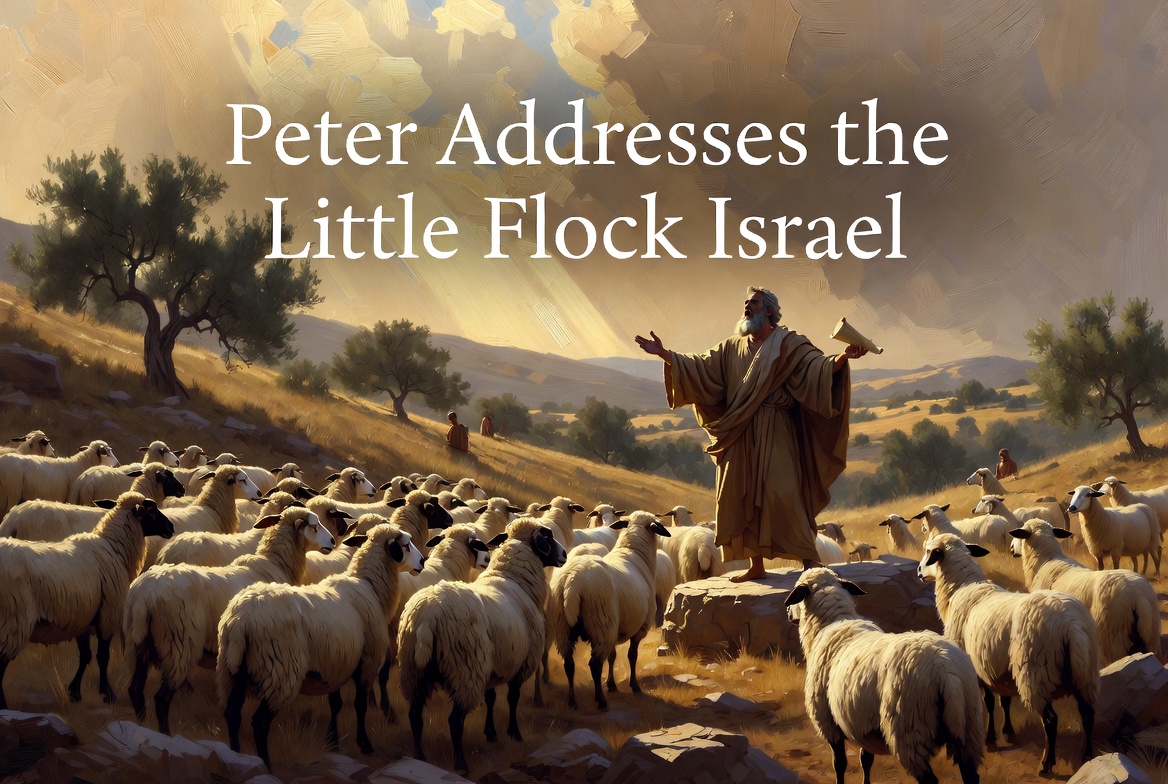
Peter later picks up the same “born again” terminology when writing to the scattered Jewish remnant (the little flock):
“Being born again, not of corruptible seed, but of incorruptible, by the word of God…” (1 Peter 1:23 KJV)
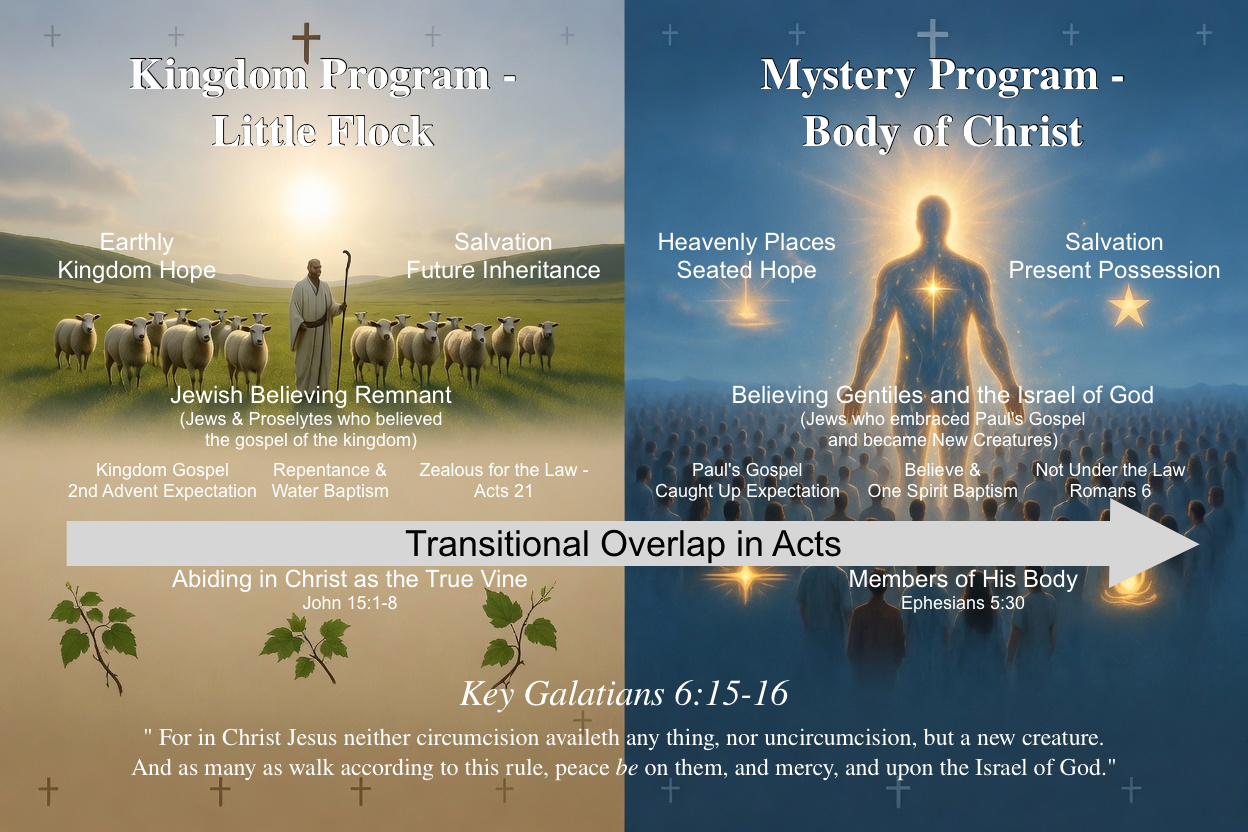
These promises were tied to Israel’s cleansing and their earthly kingdom hope. They belong to the prophetic program spoken by the prophets since the world began.
Paul’s Distinct Language for the Body of Christ
Search Paul’s thirteen epistles. You will not find him telling the body of Christ they must be “born again” or “born of the Spirit” in the John 3 sense. Instead, he gives us fresh mystery truth:
“Therefore if any man be in Christ, he is a new creature: old things are passed away; behold, all things are become new.” (2 Corinthians 5:17 KJV; see also Galatians 6:15)
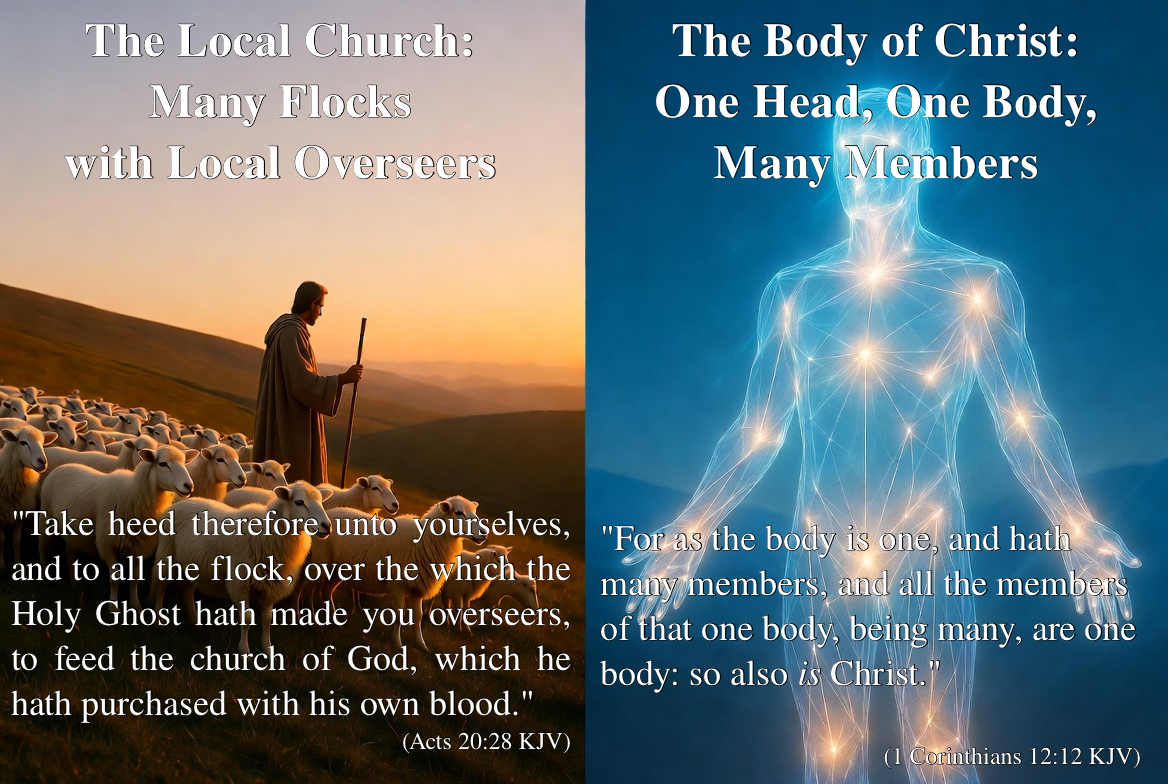
We are quickened (made alive) together with Christ and seated in heavenly places (Ephesians 2:1-6; Colossians 2:13). We are sealed with the Holy Spirit the moment we believe (Ephesians 1:13), and placed into the one body by one Spirit (1 Corinthians 12:13; Ephesians 4:4-5).
We are not waiting for a national new birth. We are already brand-new creations, already complete in Him. This is the distinct revelation committed to Paul for this dispensation of grace.
The Washing of Regeneration and Renewing of the Holy Ghost
Paul does use the word “regeneration” once, but notice the context and the exact wording:
“Not by works of righteousness which we have done, but according to his mercy he saved us, by the washing of regeneration, and renewing of the Holy Ghost; Which he shed on us abundantly through Jesus Christ our Saviour.” (Titus 3:5-6 KJV)
This is not a reference to water baptism or the John 3 new birth. Paul immediately rules out works: “Not by works of righteousness which we have done.” The “washing” here is the cleansing accomplished by the Spirit at the moment of salvation—part of the renewing that makes us new creatures. It is the same truth he teaches elsewhere: we are washed, sanctified, and justified “in the name of the Lord Jesus, and by the Spirit of our God” (1 Corinthians 6:11).
Paul’s washing is with the Word—the word of the Spirit. He makes this clear in Ephesians:
“That he might sanctify and cleanse it with the washing of water by the word.” (Ephesians 5:26 KJV)
This renewing is not a one-time event only. Paul describes it as ongoing:
“For which cause we faint not; but though our outward man perish, yet the inward man is renewed day by day.” (2 Corinthians 4:16 KJV)
The renewing of the Holy Ghost is the ongoing work that follows our instant identification with Christ’s death, burial, and resurrection. It fits Paul’s pattern perfectly: salvation and our new position are by God’s mercy and grace, not rituals or human effort. It stands in sharp contrast to the water-and-Spirit new birth Jesus described to Nicodemus for Israel’s kingdom program.
Born After the Spirit — Paul’s Allegory
In Galatians 4, Paul uses the story of Ishmael and Isaac as an allegory about the two covenants:
“But as then he that was born after the flesh persecuted him that was born after the Spirit, even so it is now.” (Galatians 4:29 KJV)
An allegory is a story or picture in which people, things, or events represent something else. Paul is not giving a doctrinal formula for how the body of Christ is saved. He is illustrating law versus grace, flesh versus promise. Ishmael was born “after the flesh” (Abraham’s effort through Hagar—the bondwoman, representing the law). Isaac was born “after the Spirit” (the son of promise, born supernaturally). No one teaches that Isaac was born again. Paul explains:
“Which things are an allegory: for these are the two covenants…” (Galatians 4:24 KJV)
Understanding it as an allegory keeps us from misapplying it as a salvation formula for the church. The Galatians were being pressured to mix the old covenant with Paul’s gospel of grace. Paul’s point: You are children of the free woman (grace/promise), not the bondwoman. Stand fast in the liberty wherewith Christ hath made us free (Galatians 5:1)!
“Born Again / Born of the Spirit” Are Not Equivalent to “Born After the Spirit”
It is important to see that the “born again / born of the Spirit” language in John 3 is not equivalent to Paul’s “born after the Spirit” in Galatians 4.
John 3 describes a prophetic, national new birth for Israel tied to the kingdom of God, water, and the Spirit—something the prophets foretold and that Nicodemus, as a master in Israel, should have known.
Galatians 4 uses “born after the Spirit” in an allegory to contrast two covenants and two ways of producing fruit: flesh (law/works) versus promise (grace/faith). It is not a salvation formula for the body of Christ, nor is it the same as the new birth Jesus described to Nicodemus.
Paul never equates our position in the body of Christ with being “born again” in the John 3 sense. Trying to make them the same blurs the dispensational lines and pulls us back into Israel’s program instead of resting in the mystery truth of the new creature.
Paul — “Born Out of Due Time”
Paul himself uses birth language in a unique way when describing his own apostleship:
“And last of all he was seen of me also, as of one born out of due time.” (1 Corinthians 15:8 KJV)
“Born out of due time” (or “as one untimely born”) pictures a premature birth. The twelve apostles were chosen during Christ’s earthly ministry in the kingdom program. Paul was called later—after the resurrection and after Israel’s rejection—directly by the risen, glorified Christ on the road to Damascus. He was “born” into apostleship out of the normal sequence. This in no way indicates a spiritual new birth like John 3; it is simply a vivid picture of the unusual timing of his apostleship and the distinct message given to him for the Gentiles. It further shows the dispensational shift: Paul’s ministry and message are distinct from the twelve and from the kingdom new birth promises.
The Early Church Fathers and the Link Between “Born Again” and Water Baptism
As the church moved away from Paul’s distinct message and began blending kingdom truths with the mystery, many early writers tied “born again” directly to water baptism. This shows the historical drift that Paul warned about.
- Justin Martyr (c. A.D. 150), in his First Apology, wrote that in the washing of baptism “we are regenerated… born again” and that this is the fulfillment of John 3: “They are brought by us where there is water, and are regenerated in the same manner in which we ourselves were regenerated.” He explicitly links the new birth to the water rite.
- Irenaeus (c. A.D. 180), in Against Heresies, taught that baptism is “the washing of regeneration” and that believers are “spiritually regenerated as newborn babes” through the sacred water.
- Tertullian (c. A.D. 200), in his treatise On Baptism, declared: “Happy is our sacrament of water, in that, by washing away the sins of our early blindness, we are set free and admitted into eternal life… The birth of the new man in water and the Spirit is the new birth.” He insisted that without baptism there is no salvation and that the new birth is accomplished in the water.
These and other post-apostolic writers increasingly connected the new birth to the ritual act, moving away from the instant new creation Paul describes by faith alone in the finished work of Christ.
From a Mid-Acts perspective, this mixing of programs helps explain why so much of professing Christendom today still emphasizes water baptism alongside or as part of the new birth. It is the natural result of failing to rightly divide and follow Paul as he followed Christ.
The Modern Resurgence of “Born Again” Among Evangelicals
The term “born again” saw a powerful resurgence in the 1970s as the standard evangelical shorthand for personal salvation. While the concept and phrase had been part of evangelical vocabulary for centuries, the 1970s turned it into a major cultural and political phenomenon.
The idea traces back to the 18th-century revivals. John Wesley preached “ye must be born again” in his famous sermon The New Birth. 19th-century revivalists such as Charles Finney, D.L. Moody, and Billy Sunday made the new birth central to their messages. In the mid-20th century Billy Graham popularized it on a massive scale through his crusades. Graham often declared, “You must be born again,” and in one sermon said, “Jesus said you have to be born again before you can go to Heaven.” His 1950s–1960s crusades helped keep the language alive in evangelical circles long before it hit the evening news.
The real explosion came in 1976—often called “the year of the evangelical.” Jimmy Carter, running for president, openly identified himself as a “born-again Christian.” That same year Chuck Colson released his bestselling autobiography Born Again. Colson had been a high-powered Nixon aide and Watergate conspirator. While awaiting sentencing in 1973, he was led to Christ through the witness of a friend and a copy of C.S. Lewis’s Mere Christianity. His dramatic conversion story, told in the book, became a publishing phenomenon and helped make “born again” a household phrase. Colson later founded Prison Fellowship Ministries and spent the rest of his life showing that genuine transformation comes only through Christ.
Other evangelical leaders echoed the same emphasis. The phrase moved from revival tents and crusade platforms into mainstream American culture almost overnight. What had been a staple inside evangelical and fundamentalist churches suddenly became a national buzzword.
Even though the term became extremely well-known and widely accepted in evangelical circles, the fact that something is “known” or popular does not make it true. Cultural momentum, bestselling books, political campaigns, and long-standing evangelical tradition do not determine biblical accuracy. Fidelity to the text requires us to rightly divide rather than follow what is popular or familiar. Popularity and widespread use do not support fidelity to the text when the text itself, rightly divided, points in a different direction.
From a Mid-Acts standpoint, this modern resurgence continued the same historical drift we saw in the early church fathers. It took a kingdom promise given to Israel and made it the universal salvation slogan for the body of Christ, often blurring the clear Pauline truth of the new creature.
Why This Matters for Clarity Today
When we fail to rightly divide, we blur the beautiful distinction God has placed in His Word. Israel has her kingdom promises—including a future national new birth. We have our mystery blessings: we are already new creatures, already quickened, already seated in heavenly places.
This blurring is part of a broader evangelical movement that coins catchy, easy-to-remember phrases and quickly elevates them to the level of core doctrine without carefully examining them in the light of rightly dividing the word of truth. Phrases like “born again,” “ask Jesus into your heart,” “accept Jesus as your personal Savior,” “make Jesus Lord of your life,” and “pray the sinner’s prayer” sound spiritual and are very memorable. They roll off the tongue easily and make for effective evangelism tools. Because they are simple and emotionally appealing, they spread quickly through books, crusades, sermons, bumper stickers, and testimonies.
The problem is that popularity does not equal truth. Just because a phrase is well-known, widely used, and feels right does not mean it accurately reflects Paul’s clear teaching for this dispensation. When we adopt these slogans without testing them against the epistles of Paul, we can unintentionally superimpose a meaning on the text that simply isn’t there. We end up teaching a blended message that mixes Israel’s kingdom hope with our mystery truth, obscuring the glorious liberty and completeness we already have in Christ right now.
When someone asks, “Have you been born again?” how can you lovingly point them to Paul’s “new creature” truth while honoring the proper place of John 3? That distinction keeps the gospel of grace pure and helps believers walk in the joy of who they already are in Christ.
© 2026 Edward R. Cross